Showing posts with label Albert Brooks. Show all posts

Tuesday, August 2, 2016

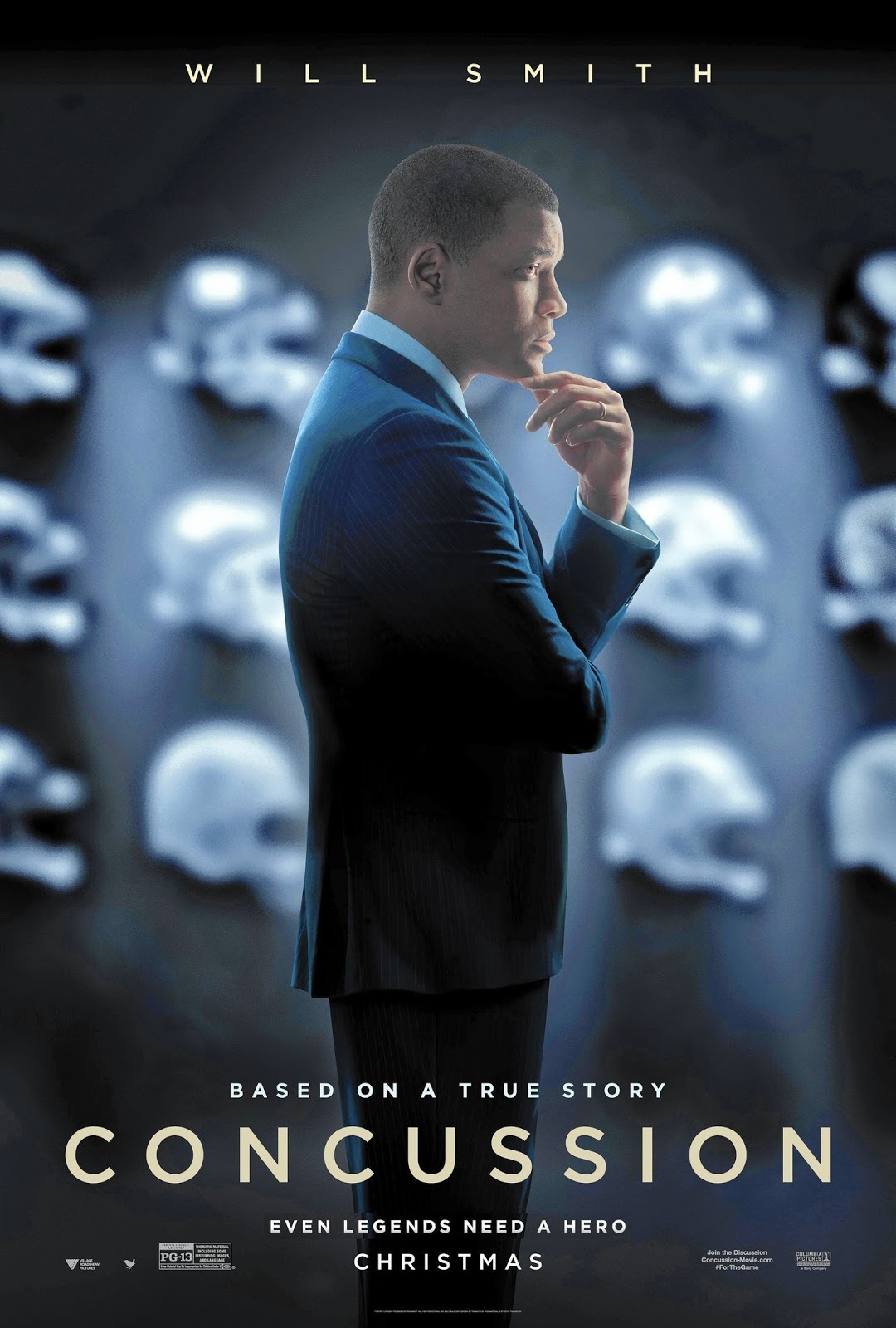
Movie Review: "Concussion"


Concussion (2015)

PG-13

3.5 Stars out of 5
Director                                Peter Landesman
Writer                                   Peter Landesman (screenplay), Jeanne Marie Laskas (GQ Article)
Cinematography                 Salvatore Totino
Editing                                  William Goldenberg

Will Smith                            Dr. Bennet Omalu
Alec Baldwin                       Dr. Julian Bailes
Albert Brooks                      Dr. Cyril Wecht
Gugu Mbatha-Raw             Prema Mutiso

David Morse                       “Iron” Mike Webster
Luke Wilson                        Roger Goodell
Matthew Willig                  Justin Strzelczyk


“Finishing the game is the same as winning the game.”

Mike Webster

“You think you’re being a good American. The NFL owns a day the week, the same one once owned by the Church.”

Dr. Wecht to Dr. Omalu

There was an excellent movie in 1999, “The Insider” (from the always brilliant writer/director Michael Mann). It is in fact one my Top Ten Movies from the past 25 years. The critics loved it, the public, not so much. What it did so well and what “Concussion” largely fails to do, is to build real tension within its story of a major American industry’s efforts to kill the science being used to discredit the products sold by that industry. The product in question in “The Insider” was tobacco; pretty clearly a villain to most Americans in 2016. This was most definitely not the case throughout most of the 20th century. Mann did not leave his kid gloves on with his film as he excoriates “Big Tobacco”. The product in question in “Concussion” is NFL football. And if tobacco products were easily seen as a villain by many Americans, even before they were proven to be so, this is definitely not the case with America’s most popular professional sporting event. Writer/director Peter Landesman knows the popularity of football and the financial reach of the NFL, and as such his movie (likely with some nudging from corporate parent Sony Pictures – according to leaked internal memos) does leave his kid gloves on as he tries to take a somewhat evenhanded approach to the now proven link between concussions sustained while playing football and high rates of dementia amongst their retired player veterans.

“Concussion” was inspired by a September 14 2009 GQ article by Jeanne Marie Laskas, “Bennet Omalu, Concussions and the NFL”. It is a hard hitting article that pulls no punches. Landesman’s movie discusses much of what is wrong with how the NFL reacted to Omalu’s report on the effects of concussions as detailed in the article, but struggles to find a dramatic arc to the story. The story begins with a moving portrayal by David Morse of retired Pittsburg Steeler’s center, “Iron” Mike Webster. Webster is giving a speech following an award ceremony in his honor. Webster reels slightly, he seems to speak with some difficulty and to stand up straight. There is a sense that something is amiss, but it is not clear what that something is.

The film then turns to an unrelated trial where we meet Dr. Bennet Omalu (Will Smith). He is a forensic pathologist in the Allegheny County Coroner’s office and is at the trial on behalf of the accused. He is faced with some skepticism from the district attorney about Omalu’s credentials. Omalu quickly disabuses the DA’s concern over Omalu’s medical credibility via a long list of medical degrees and fellowships. Was Omalu’s competency questioned due to his race or thick Nigerian accent? It is not clear, but it is a theme that will be repeated throughout the movie: people will automatically discount him from Dr. Omalu to Mr. Omalu, and amongst his medical colleagues, his scientific acumen will often be discounted from scientist to merely “someone working in the county coroner’s office”. The movie will take pains to make this point of barely suppressed racism.

The movie will also in this first scene with Omalu make a mistake that will carry on throughout the movie with many examples. In this case, the viewer is teased with the knowledge that Omalu may have brought forth via his training and genius facts that would reverse the verdict against the accused, but the viewer will never know. The story is introduced, but dropped without resolution. The film has many examples of errors that I will loosely categorize as continuity mistakes. Two more big ones include a loss of a sense of the passage of time to the viewer, and a very sloppy introduction of minor actors. That is to say, how much time has passed during the film’s progression, is it months or years; it is far from clear. And who are the various members in the NFL cast of characters? We see them grimace and say rude things about Omalu, but are they minor actors within the NFL or major ones? Again, the viewer will be very hard pressed to puzzle most of them out.

As the movie progresses, we see Webster’s condition deteriorate. It is heartbreaking. If the viewer thinks about Webster at 25 or any of his colleagues, they were among America’s most fit, most athletic citizens. Then they retire in their 30’s, and by the time they are in their 50’s, they are decrepit or mad or both. To watch how Webster and the others (the movie will show in minor detail several more) as their mental and physical conditions worsen, is truly shocking. Has the movie exaggerated these situations? Google San Diego Charger Junior Seau’s death in 2012 to review a case that is not in the movie, but is very compelling on the effects of multiple concussions. You will be persuaded of the danger that awaits many retired NFL players.

At Webster’s death, Omalu will find a problem he cannot readily explain. He sees it as his duty to the deceased and their families to find an explanation. How did someone at 50 go mad when there were no physiological, anatomical or historical evidence for it? Omalu will with the support of the coroner, Dr. Cyril Wecht (a somewhat serious Albert Brooks) begin an investigation that he will pay for with his own money. Wecht will support him politically, as will a couple more, but for the most part, Omalu will be running alone a gauntlet to get the investigation done, published, and most significantly understood by the NFL and American public.

Omalu will find microscopic tears in the neuronal cells of the Webster’s brain. He will name them Chronic Traumatic Encephalopathy or CTE; they cannot be found via medical imaging such CT scans. Omalu will theorize their origin is related to how the human brain is untethered in the skull, and as such can move with great force into the interior wall of the skull during a collision. He will eventually write a peer-reviewed paper with Dr. Wecht and local Neurologist Guru, Dr. Steve Dekosky. As with others within the medical world, it was a struggle for Omalu to get Dekosky attention, let alone his respect. But the data was irrefutable, and the paper written. Part of Omalu’s argument used to persuade DeKosky was a comparison of various animal species that can withstand repeated head collisions (e.g. woodpecker or male rams). Omalu noted that a concussion can occur at 60G’s and that a typical head to head football collision is roughly 100G’s. He concluded with his calculations that Webster had suffered some 70,000 such collisions from the time he started as a child player to his last day as a Pro player.

These arguments are persuasive to anyone willing to listen. They should have been more than sufficient to at least get meetings with the NFL to discuss them. Poor Dr. Omalu did not understand the priorities of the NFL. Little did he know that player safety was a very distant second to profits. Omalu’s paper will begin a program of denial and professional disgrace that the NFL will direct towards Omalu and Wecht. Had one more player in this drama not entered the story, Omalu’s research may well have been buried and forgotten until the next scientist with the right about of curiosity, ability and integrity chose to investigate it. In this case, a new medical doctor comes onto the scene, Dr. Julian Bailes (well played by Alec Baldwin).

Bailes is the former team-doctor to the Steelers and someone who consider Mike Webster a friend as much as a patient. Bailes had opportunity to personally watch Webster’s descent into madness. He also carried a burden of guilt. This guilt stemmed from his days as the team’s doctor where he would do everything he could to get a player back into the game as quickly as possible, no matter the consequences. Bailes will lend his credibility and NFL connections to Omalu’s efforts. This will result in a summit called by the NFL’s commissioner, Roger Goodell (Luke Wilson). Omalu will not be allowed to speak, but Bailes will. Omalu is frustrated and humiliated. But in the end, the result is the same as if he had spoken, the NFL will publically conclude that there is no connection between football and concussions, let alone the madness and the CTE Omalu’s research had identified.

What will cause a sea change within the NFL or at least within the players and their union is the growing number of suicides and insane behavior in their retired players. It will raise eyebrows when Justin Strzelczyk (Matthew Willig) drives his car into oncoming traffic, but it is the suicide death by a gunshot to the head by NFL insider Dave Duerson that gets the most attention. Duerson was not only a retired player but had in fact begun to mount a campaign for mayor. Like other NFL insiders, he chose to ignore the evidence and instead focused his ire at Omalu over the losses he imagined would come if the NFL were constrained in some manner. He like others assumed there was only one path forward, no change to current NFL policies; any other path would lead to corporate death. When his own life became threatened by CTE, when he could no longer assuredly control his anger, when he recognized he was a threat to his family, he finally decided the wealth he personally gained from his association with the NFL was too high a price to pay. Just like so many other examples in life, one more man whose decisions in life had been guided by his pocketbook, will too late realize that his life and that of his family faced greater dangers by decisions made solely on the basis of greed than by making decision on the evidence brought forth by science.

As I write above, there is much to admire about “Concussion” and unfortunately a number of things to decry. The acting by Smith and Baldwin is first rate; it is a major pity, Smith was not nominated for an Oscar as Best Actor (his curious Nigerian accent notwithstanding). The best scene in the movie is one by a river where Omalu is re-assured by his wife Prema (Gugu Mbatha-Raw); her role is generally understated, but she provides reassurance to Omalu throughout the movie; most especially in this scene. The editing is also quite good. There are several storylines that must be melded seamlessly in order to create a unified whole, and film editor William Goldenberg does a very good job of it. The direction by Peter Landesman coupled with the cinematography by Salvatore Totino capture in slow motion a kind of grace in the various plays of football. It is the writing and the possible political motivations behind it to tone down the accusations against the NFL where this movie disappoints. With respect to the science, there is virtually none shown or explained. We briefly see a microscopic view of a torn neuron, but no explanation to speak of; even the pitch made by Omalu to Dekosky focuses on the animal parallels of head butts. Given so little real science as presented in this movie, it is no wonder, that the NFL was unconvinced.

The final scenes of this movie are where it is both successful and a disappointment. On the one hand, the closing graphics tell us that 28% of all NFL players will have CTEs and that the NFL settled some 5000 player originated lawsuits over concussions with the stipulation that no admission of a connection between concussion and player injury be made. Sounds pretty conclusive, right? And yet when the writer/director and studio had a good opportunity to show a picture of what was at stake, they pulled back. This final image is of two twelve year olds playing football. They launch themselves at one another; their heads are aimed for a horrific, but all too common collision. The film ends without the collision. There may well be reasons not to have staged this hit with actual actors, I understand the need for safety (and wish the NFL did so too). But it feels like a kind of cinematic cop out. It reminds me of the half steps this movie takes in truly taking on the NFL. I came away partly shocked by this movie’s revelations, but mostly with the conviction that either the NFL got to Sony, or Sony was too afraid to go after them and their constituency.

Bottom-line: this movie is watchable, but far from a great expose of a problem that in all probability affects every child in America playing football. A nice aspect of the movie is watching an immigrant with such a love for America that he will state at one point, “America is where God sent his favorite people”; it is a thought provoking moment that stands in contrast to the NFL’s greed. But if you want to see a truly great expose of Big Business burying the science that exposes their unscrupulous malfeasance, go see “The Insider”.

Saturday, June 18, 2016

Movie Review: "Finding Dory"


Finding Dory (2016)

PG

4 Stars out of 5
Director                                Andrew Stanton, Angus Maclane
Writer                                   Andrew Stanton, Victoria Strouse, Bob Peterson

Ellen DeGeneres                 Dory
Albert Brooks                      Marlin
Ed O’Neill                             Hank
Kaitlin Olson                        Destiny
Hayden Rolence                 Nemo
Ty Hardin                             Bailey
Dianne Keaton                    Jenny, mom
Eugene Levy                        Charlie, dad
Idris Elba                              Fluke
Dominc West                      Rudder
Bob Peterson                      Mr. Ray
Sigourney Weaver             herself

 
“I look at you, and I’m home.”                   Dory

 
I’m sitting in a dark room, filled with children and their parents. Surrounded by an audience filled with anticipation; my wife, adult daughter and her three kids, my grandchildren are here, too, also filled to the brim with excitement. We’re all here for the new Disney/Pixar movie, “Finding Dory”. The happiness in the room is blessed balm from this week’s stories from the outside world. For the next two hours or so, we can all escape to a place filled with love and joy. And within moments of the movie’s beginning, with my daughter and her eldest daughter’s laughter echoing through the room, it begins…

In the summer of 2016, the summer of sequels, Disney/Pixar has released a long awaited sequel to 2003’s “Finding Nemo”. This new movie has with justification recently been promoted by Ellen DeGeneres; she as Dory in “Finding Nemo” was the comic highlight in that film. Now in 2016 after Disney gave the movie the green-light roughly in the summer of 2012 when they announced they had signed “Finding Nemo” director Andrew Stanton to come back for the sequel, the world, or a good chunk of the English-speaking part of it and certainly Ellen was filled with anticipation. She and Albert Brooks were announced a year after the Stanton announcement in 2013 to have agreed to reprise their roles of Dory and the worry-wart of a father to Nemo, Marlin. Initially, back in 2005 Disney in the midst of their protracted snit with Steve Jobs had decided to farm out the sequel to a subsidiary; but in 2013 it was to be time for Pixar magic once again. The release date was pushed back from the fall of 2015 to the summer of 2016. Now, the only question is, could Pixar duplicate the magic they accomplished with another sequel, “Toy Story 2” (1999), i.e. a sequel superior to its progenitor? Well, in the words of my granddaughters and adult daughter: “yes”!

Yes, to be absolutely certain, “Finding Dory” works to repeat the charm, poignancy and sentimentality of “Finding Nemo” and it does so in fine fashion. Your children will laugh as my granddaughter did when the sweet but nearsighted whale shark, Destiny (Kaitlin Olson) runs into the wall of her tank, or when the bug-eyed Loon, Becky (unvoiced) goggles her eyes at Marlin and pecks him on the noggin for no apparent reason. The sight gags work great for the kids and they will have fun. There isn’t the clever two layered topical joking of "Aladdin" where kids and adults can laugh at the same joke, though for different reasons. But chances are you will find yourself laughing alongside your kids, if only for the joy of their joy.

One minor problem for me as an adult, is that “Finding Dory” repeats with considerable rigor the various plot points in “Finding Nemo”: there is a lost waif, a vicious carnivore that does not get his way, various dark places to swim through, amusing helpers that bark out amusing monosyllabic threats (remember “mine”, now look for “off” from Idris Elba of all people; this is one of the adult level jokes in the movie – see “Beast of No Nation” for a prolonged explanation of why), and of course an ingenious escape from a trap that seems quite reasonably impossible to adult human eyes to escape from. So, yes, the plot worked the first time for its cleverness and sentimentality, and it works here, too for the same reasons, but it is a little derivative. I might have yearned for the pathos of “Up” or the wit of “Aladdin”, but the non-stop laughter coming from my daughter and grandkids, makes such yens quite irrelevant. “Finding Dory” may not reach the sky-high levels of these two predecessors, but it does quite nicely equal “Finding Nemo”, and for the kids, that is quite enough.

For the adults and their enjoyment, it is truly amazing what can be done with computer-generated animation these days. To help prepare the adults, “Finding Nemo” was preceded in our theater by an animated short called “Piper”. Anyone would be excused for believing (as I did for several moments) that based on the visuals, this short was a live action short. I could not find one single aspect of the animation to find fault with. “Finding Dory” continues with this exceptional level of animation. “Finding Dory” won’t be confused with live action movie the way “Piper” was due to the cartoonish depiction of the characters being portrayed, but the underwater lighting and color of the kelp beds is, I can assure you as a scuba diver, as close to reality as an actual live action film might have been. It was breathtaking. Other scenes such as those within the “Open Ocean” exhibit at the Moro Bay Marine Life Institute (where the bulk of the movie takes place) create their own versions of breath taking animation. These parts of the movie are simply remarkable. Every adult will enjoy the movie for the visual treat it is designed to be, and is.
 
There are a few comedic aspects that I had wished might have been improved on. Ed O’Neill’s performance as the reluctant helper Octopus/”Septopus” (he’s down one tentacle due to a rambunctious child visitor to the center) to Dory has several scenes where his role as curmudgeon provides occasional comic relief. Two sea lions outside the Center (Idris Elba as Fluke and Dominic West as Rudder) also provide some comedy, though less I think than was intended. These three actors perform adequately as comedians, they just do not stand out as such. Instead, the most amusing character in the movie is the Loon, Becky, who apparently spent too long in the 60’s of California. She provides "help" of a visually comedic and quite unreliable sort to Marlin and Nemo. And lastly, for the adults, the inclusion of Sigourney Weaver as the recorded voice for the Moro Bay Marine Center (that Dory hears from afar as a source of help) also provides a sly kind of humor.
In terms of writing, it is clever in the way writers Andrew Stanton, Victoria Strouse and Bob Peterson intentionally write Dory, Marlin and Nemo into corners that it does not seem possible for them to extricate themselves from. But in the manner of the dentist’s aquarium in “Finding Nemo”, the writers do find clever ways that may push an adult’s credulity to its limits but it most likely merely entertains the child (and those that are children at heart). It’s time for me and the like-minded to stop being a scientist, worrying about logic (these are after all talking fish), and just go with the crazy childlike logic of an octopus fixated on getting to Cleveland. I’m there and enjoyed it, right up to the final denouement. I loved the use of the sea otters to get there, they are cute and lovable, and using them as a plot device was funny and effective in this crazy Pixar world. My only small complaint about the writing was maybe they pushed movie-land silliness a little too far with a truck-driving octopus*.

Lastly, for the adults, the closing song of Nat King Cole’s “Unforgettable” sung here by Sia will be another gift for viewers of a certain age; it is both a nostalgic and an empathic ending to the beautiful imagery and emotions they just witnessed in the movie.
Anyway, it’s a fine sequel to “Finding Nemo”. It’s a little less witty, and perhaps does a less effective job of turning a “disability” into a strength than it did in “Finding Nemo”, but without question your grandkids, your adult kids, and in all probability you will love it, if only to see old friends that are like family once again! Go see it, its summer time, after all.


*I read that following the release of the documentary “Black Fish” and its criticism of life within a Marine Exhibit, that the ending was changed away from such a final destination for our piscine heroes to one of the open ocean. Who knows, if maybe the final ending was a last minute change; to me it feels a little forced.

Tuesday, September 8, 2015

Movie Review: "A Most Violent Year"


A Most Violent Year (2014)

R

4.5 Stars out of 5

Writer/Director                 J.C. Chandor

Cinematography              Bradford Young

Music                                  Alex Ebert

Oscar Isaac                         Abel Morales

Jessica Chastain                Anna Morales

Albert Brooks                    Andrew Walsh

Elyes Gabel                        Julian

David Oyelowo                 District Atty. Lawrence


Since the 1970’s through the 90’s, movies like “The Godfather”, “Scarface”, and “Goodfellas” (amongst others) have set the tone in American filmdom for a kind of cinematic cult. Certainly it is genre, but the almost slavish adherence to the cinematography used with respect to framing, lighting and color plus the use of a central character as anti-hero, must make one wonder whether there is a school of thought and technique that many directors feel must not be violated. That just like the mafia life they depict in the movies, Coppola, De Palma and Scorcese (and others) make their movies to a code as strict as the code of omerta that guides the Mafia itself. In 2014, J.C. Chandor took on this code with his movie, “A Most Violent Year”. He took it on, adopted it, challenged it, and with a few minor missteps, improved on it.

Chandor has written and directed the story of Abel Morales (Oscar Isaac), the owner of a heating oil distributor in 1980’s New York. He is married to the daughter of the previous owner; an owner that practiced a much harsher and more illegal brand of corporate vision. Abel had worked himself up from driver and appears to be an immigrant. He hires others with a similar background; one of whom is Julian (Elwes Gabel). We first meet Julian on one of his runs to deliver heating oil to the company’s clients. On the way to make his delivery, he is stopped on the expressway and assaulted, his truck hijacked. We learn this has been going on for months and Abel’s business is suffering. His wife Anna (Jessica Chastain) in a Lady Macbeth-like manner that is true to her mafia father’s upbringing urges Abel to arm his drivers and to make a vigorous (read violent) response to his enemies. Abel, however, true to his nature and to the story’s premise, refuses to do so. He argues then and throughout the movie, that responding with violence will worsen the situation, not improve it.

When Abel seeks legal redress from the law,  District Attorney Lawrence (David Oyelowo) gives him a very frosty response. As Abel is soon to learn Lawrence is about to bring 14 counts of price fixing, tax evasion and various misdemeanors against Abel. Lawrence has been tasked to clean up the heating oil business and decided to focus on Abel, at least in part because of the legacy left to him by his decidedly not-by-the-book father-in-law. However, Abel remains polite, acknowledges the hard work Lawrence must do and leaves. To be sure, Lawrence thinks that Abel is being disingenuous and thinks Abel’s behavior is only an act. But this is in fact the real Abel. He does everything according to the law and with deep and true respect to everyone he meets; he may look like a gangster based on his clothing but he has the heart of good man. Whether Abel is polite and law-abiding or not, he is nevertheless ambitious and wants to grow his company. He does this by outplaying his competition on their home turf, likely creating the enemies he fears is hijacking his trucks. However to truly grow, he needs a new facility for his operations. As such, with the assistance of his attorney Andrew Walsh (Albert Brooks) he has entered into a 30 day escrow with a neighboring company that wants to exit the business. They are a Hasidic family-owned company with a heating oil tank farm that has many unused tanks and water access – two features Abel desperately needs. The problems mount for Abel as he tries manfully to meet the 30 day deadline on his escrow. If he fails to come up with the balance for the purchase of the property, he loses his down payment and ultimately his business. The attacks on Abel’s business by unknown parties continue, Julian makes several fatal mistakes, and his enemies seem to have Abel in a corner from which there is no escape.

The movie is filmed in browns, ochre, and with many of the interior scenes, in deep shadows. Abel is always dressed impeccably and always with a coat to match the cinematic color palettes used in the older mafia movies.  While these techniques alone might well do justice in honoring the older films, there is a scene where Julian is first attacked just past an expressway toll booth that seems to directly link this movie to the “Godfather” and Sonny’s departing scene. However, unlike Sonny’s exit, no one is shot. Later when Julian is attacked again, and despite having armed himself, again no one is shot. Chandor has the characters in this movie get so close to violence, but just not quite there. This appears at times to almost be a tease to the audience: will Abel or Anna or Julian actually defend themselves with a gun or not. It is an unusual kind of dramatic tension – certainly not one normally practiced in the iconic mafia films of the late 20th century.

Another notable technique Chandor uses in multiple scenes is a very sedate pacing; often slowing the action down to a normal, non-cinematic pace. People talk in reasonable dialogs, rarely is there a sense of menace in their actions or voices. Even when Abel finally comes close to losing his temper in a meeting with his business rivals, he barely does so, and none of his rivals do much more than blandly stare back at him. No, the violence in this film is not really in the central story being told, but rather in the surrounding atmosphere. That atmosphere is highlighted by Greek Chorus-like voice-over radio descriptions of unrelated violence in the city. In fact, the title refers to the fact that 1981, the year the movie depicts, it was the most violent year in New York’s history (sadly, since eclipsed). The ironic contrast between the violence elsewhere in the city and the only near-violence surrounding Abel, or the contrast between this movie and its cinematic antecedents is striking.

Chandor has created a different kind of dramatic tension, one that more closely mirrors normal everyday life: will Abel get the loan and save his business or won’t he? There is also the artificial Hollywood tension: will Abel finally lose his patience and use the pistol he took from his wife. This is not to say that Chandor does not use some Hollywood tricks. Consider the scene where a car driven by Abel is raced at high speed through a dark, dust-choked tunnel. It is exciting and nerve-wracking as you wonder how it will end. But in this movie, it is far more likely a metaphor for Abel’s groping attempts to discover who his enemies are. It would be a major spoiler to reveal them here; suffice to say, their identity remains true to this movie’s core meaning: life is not a Hollywood movie. There are good people with some bad tendencies; tendencies that are sometimes acted on directly, but more typically, are simply allowed to happen with a wink and a nod. “A Most Violent Year” does honor the earlier mafia movies, but it is more importantly homage to normal life. A life filled with people who may well break the law, who certainly display a very poor understanding of right and wrong, but quite frankly simply don’t go around shooting people like Scarface with large caliber machine guns in their own living room.

This movie is beautifully made, intelligently inspired, and wonderfully acted. Indeed, the acting by Oscar Isaac continues to impress me (see also the recent HBO mini-series, “Show Me a Hero” for a poignant performance by Isaac that will leave you seriously moved). There are few points that I found wanting: an underused Jessica Chastain and a completely unbelievable exit scene by Julian. But otherwise, sit back and enjoy the life like pacing, the Autumnal color palette, the breathtaking cityscapes, and admire the real people that inhabit this movie, just as they inhabit the world we live in.